Skinport Fees (2026): 8% Seller Fee, 6% From 1,000, 2% Private
Skinport takes 8% of the sale price from the seller, 6% on public listings priced at 1,000 or more in USD or EUR (£800 in GBP), and 2% on a private middleman listing. It pays out by bank transfer only and charges nothing for the payout. That is the whole schedule as we read it on Skinport's FAQ and blog on 13 October 2026.
Who it suits: sellers who want money in a bank account rather than Steam credit, especially on expensive items or when a buyer is already lined up. Who should skip it: a patient seller of cheap items, who keeps more on a 2% peer-to-peer listing, and anyone living in a country Skinport's payment provider doesn't pay out to.
Skinport's fees in one table
Every line below is Skinport's own published wording, with the page it came from. Older guides still quote 10% or 12% for the standard fee; both have been out of date since 18 July 2025.
| Listing type | Fee | When it applies | Source |
|---|---|---|---|
| Public listing | 8% | Below the high-tier threshold | FAQ; blog 18 Jul 2025 |
| High-tier public listing | 6% | 1,000+ USD or EUR, 800+ GBP, 1,500+ CAD, 1,600+ AUD | High-tier blog table |
| Private listing (middleman) | 2% | Any price; buyer needs your direct link | FAQ |
| Bank payout | Free | After KYC tiers are met | FAQ |
| Buyer-side fee | None published | The fee answer covers sellers only | FAQ |
Two details in the small print change the arithmetic on cheap items. The fee is rounded up to the next euro cent, so the minimum charge on any sale is €0.01. And because the fee already includes VAT, there is no tax line added later on the seller side.
Affiliate link. We may earn a commission — it never moves a ranking.
What the 8% buys you
A public $100.00 sale credits you $92.00, which looks expensive next to the 2% charged by peer-to-peer markets. Part of the difference is the cash-out: Skinport sends the money to your bank in your country's main currency, without a payout fee and without a currency-conversion fee. On markets that charge you to withdraw, the headline percentage is only half the bill.
The other part is a rule worth knowing before you list: Skinport has no spendable on-site balance. Its FAQ says money from sales cannot be used to buy items on the marketplace, for legal reasons. Sale proceeds go one way, to your bank. That suits someone cashing out and annoys someone who wanted to swap a rifle for a knife on the same site.
What you receive at $10, $100, $1,000 and $1,500
The table runs the published percentages through four sale prices. It covers Skinport's fee only. Your bank may charge to receive a transfer, which Skinport can't control and we can't predict.
| Sale price | Public listing | Private listing (2%) | Fee kept by Skinport (public) |
|---|---|---|---|
| $10.00 | $9.20 (8%) | $9.80 | $0.80 |
| $100.00 | $92.00 (8%) | $98.00 | $8.00 |
| $999.00 | $919.08 (8%) | $979.02 | $79.92 |
| $1,000.00 | $940.00 (6%) | $980.00 | $60.00 |
| $1,500.00 | $1,410.00 (6%) | $1,470.00 | $90.00 |
Look at the middle two rows. A skin listed at $999 pays $919.08; the same skin listed at $1,000 pays $940.00. One dollar more on the price tag puts $20.92 more in your account, because the lower rate applies to the whole price. If an item is worth roughly a thousand, list it at the threshold or above.
The 6% and 2% breaks
The high-tier rate is set per seller currency, not converted on the day. Skinport's table puts it at 1,000 for USD, EUR and CHF, 800 for GBP, 1,500 for CAD and 1,600 for AUD. There's one wording wrinkle: the table says "≥ 1,000", while the July 2025 announcement says "items over 1000€". If your price sits exactly on the line, list it one cent above so neither reading can cost you 2 points.
The 2% private listing is a middleman service. The item doesn't appear in the public market; only someone holding your direct link can buy it. That makes it the right tool when you've already agreed a price with a known buyer and want an escrow between you. It is the wrong tool for finding a buyer, because nobody browsing will see it. And it beats the alternative people actually use for private deals, trading first and hoping to be paid, which is how most skin scams start.
Fee history: 12% to 8% in July 2025
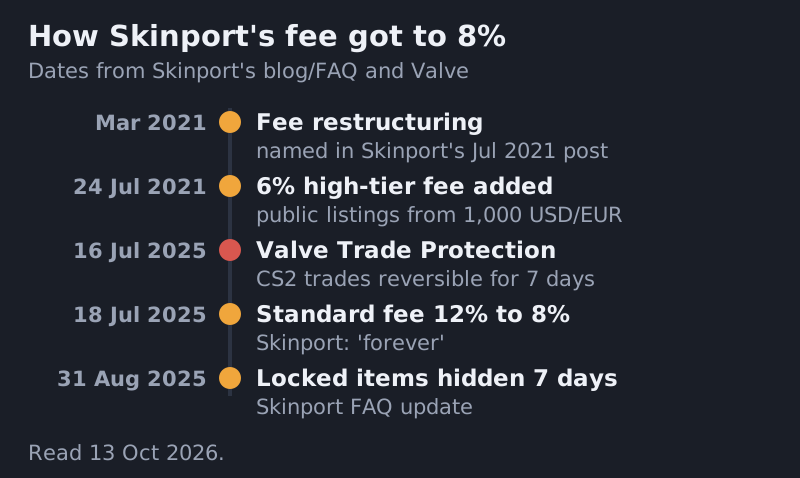
Skinport's post of 18 July 2025 announced that the standard selling fee "drops from 12% to 8% forever", kept the 6% rate for items over €1,000 and kept private sales at 2%. The high-tier discount itself is older: Skinport introduced it on 24 July 2021, for public listings above a per-currency threshold. Pages that still say 12%, or the 10% some guides quote, describe a schedule that no longer exists.
Withdrawals: bank only, KYC tiers, 1–3 business days
Skinport pays out by bank transfer and nothing else. Its FAQ is explicit that no other method is supported. The rest of the cash-out works like this:
- Speed: sale money reaches your seller account in 1–2 business days, and a bank transfer then takes 1–3 business days. Weekends and public holidays don't count.
- Schedule: automated payouts go out once a day by default; you can switch to weekly or monthly in seller settings.
- Limits: Skinport sets no payout cap of its own, but payouts pause at each KYC threshold until you complete the next verification step. The thresholds are shown on your seller account page and vary by country.
- Currency: you're paid in your country's primary currency, which you can't change, so there's no conversion fee.
- Countries: where the payment provider doesn't pay out, you can't sell. Skinport warns that using a VPN to get around this forfeits both the proceeds and the items.
The KYC step is the one that surprises people. A first sale can go through without paperwork and then stop at a threshold until you send ID. Do the verification before listing anything you need paid quickly.
Why a freshly traded item waits seven days
Valve's Trade Protection, live from 16 July 2025 (15 July in US time), lets either side of a CS2 trade reverse it for seven days. Skinport's answer, in an FAQ entry last updated 31 August 2025: trade-locked items can still be listed, but they stay hidden from buyers until the seven-day reversal window ends, then go on sale automatically.
Skinport's FAQ also keeps an older entry on a 7-day trade lock, which it says ends at 7 am UTC on the following day, so the worst case is close to 8 days. Valve's own Trade Protection FAQ now says CS2 items aren't subject to trade holds, but a received item still can't be transferred for 7 days, so the effect is the same: an item you cancel only comes back to your Steam inventory once that window has passed. Add the 1–2 days to settle and 1–3 days at the bank, and plan for about two weeks from depositing a newly received item to having the cash.
Skinport vs Steam Market vs CSFloat vs DMarket on a $100 sale
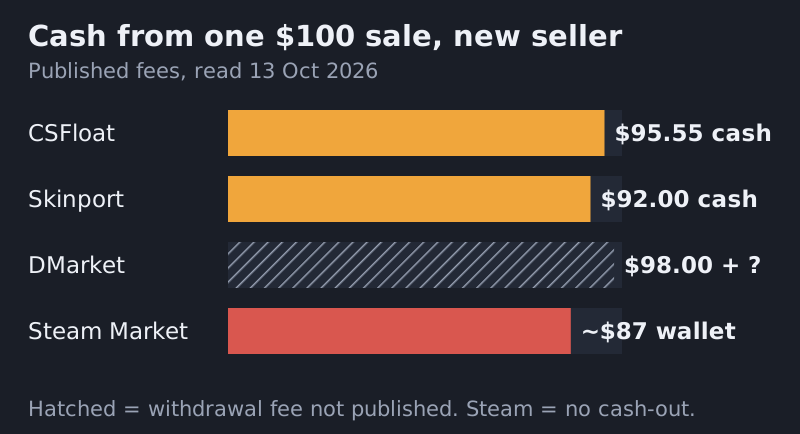
| Market | Seller fee | Credited | Cash-out cost | Cash in hand |
|---|---|---|---|---|
| Skinport | 8% | $92.00 | None | $92.00 |
| CSFloat | 2% | $98.00 | 2.5% under $2,500 sold (+0.6–1% FX if not USD) | $95.55 |
| DMarket | 2% (up to 10% on illiquid items) | $98.00 | Not published | Unknown |
| Steam Market | 15% added to your price | ~$87 wallet | Cannot withdraw | $0 |
On fees alone, Skinport loses to both peer-to-peer markets on a $100 item, by $3.55 against CSFloat for a new seller. Above a thousand, 6% narrows that gap. CSFloat also expects you to keep its browser extension or app running to track the trade, and credits your sale about 8 days after delivery. Skinport's case is simpler: no withdrawal fee to look up, and a public storefront that doesn't need you online when the sale happens. If that trade fits you, list on Skinport. If every dollar counts and you can wait, the full field is in the marketplace audit.
Affiliate links. We may earn a commission — it never moves a ranking.
Is Skinport legit? Company, track record, what can go wrong
Skinport is run by Skinport GmbH, Steiermärker Straße 3-5, 70469 Stuttgart, registered at the Stuttgart local court under HRB 764879, according to the imprint we read on 13 October 2026. It publishes its fee schedule, names a managing director, and has blog posts on its fee model going back to 2021. A German company with a public register entry, bank-only payouts and a KYC process is the opposite of a fly-by-night skin site.
Legit is not the same as risk-free. These are the problems that do happen to Skinport sellers:
- Payouts paused at a KYC threshold until you verify.
- No payouts at all from unsupported countries, and lost proceeds if you hide your location.
- A trade-locked item sitting invisible for seven days.
- Phishing copies of the site that steal Steam logins. Type the address yourself rather than following a link someone sent you.
None of them is unique to Skinport, and all four are avoidable if you read this section before listing.
Affiliate link. We may earn a commission — it never moves a ranking.
Edge cases worth a minute
- Right at the threshold: list one cent above 1,000 (or 800 in GBP) to remove any doubt about the 6% rate.
- Very cheap items: at a few cents, the euro-cent rounding makes the effective rate a little above 8%.
- Selling to a friend: use the 2% private listing rather than an off-platform trade; the escrow is the point.
- Wanting another skin, not cash: Skinport's proceeds can't be spent on the site, so a swap means two transactions.
- Steam credit is enough: if the money is going back into Steam anyway, the case for any third-party market weakens. That trade-off is covered in Steam Market vs third-party sites.
Itemized questions
What is Skinport's seller fee in 2026?
Does Skinport charge buyers a fee?
How long does Skinport take to pay out?
Does Skinport have a withdrawal fee?
Is Skinport cheaper than the Steam Market?
Balance this against the field: the best ecommerce website builders, ranked, or the marketplace audit.