Is CS.MONEY Legit? The 2022 Bot Breach, Fees by Route and Cash-Out Rules
Yes, CS.MONEY is a legitimate business, and it has a real security incident in its history. The site names two operating companies: CS Virtual Trade Ltd. in Limassol, Cyprus (reg. no. HE 389299), and G2G Marketplace Limited in Hong Kong (reg. no. 3064044). It publishes its commissions and lets verified users cash out a Market balance to a Visa card or PayPal, depending on region. In August 2022 attackers took about $6 million in skins from its trade bots. The site went offline, offered a $100,000 bounty and said it would return skins or compensate users. All of this is dated below.
Whether it's right for you depends on which part of the site you use. The P2P market charges 5%, or 3% above $1,000. Trade mode starts at 7% and can add up to 13% more. Instant sell pays a price the site sets. If you want cash and can wait about a week, the P2P route is reasonable. If you want the most money for a skin, a 2% peer-to-peer market usually beats an instant offer. Facts here come from the site's FAQ, read on 13 October 2026, and from security press published in August 2022.
What the site is: trade bot, P2P market and instant sell
Most people still think of CS.MONEY as a trade bot: you put skins in, pick skins from the bot's inventory, and the site prices both sides automatically. Its FAQ says prices are set by its own system from factors like wear, StatTrak, popularity and demand, and "not directly dependent" on the Steam Market. That's why the same skin can be valued differently there than on Steam.
Two newer routes sit beside the bot. P2P Sell lists your skin for other players to buy at your price. Instant Sell sells it to the site's bots straight away at the price offered. The routes pay into different balances, and only one of those balances can ever leave the site. Most confusion about CS.MONEY comes from mixing them up, so the next sections keep them apart.
The August 2022 bot breach: what happened and what changed
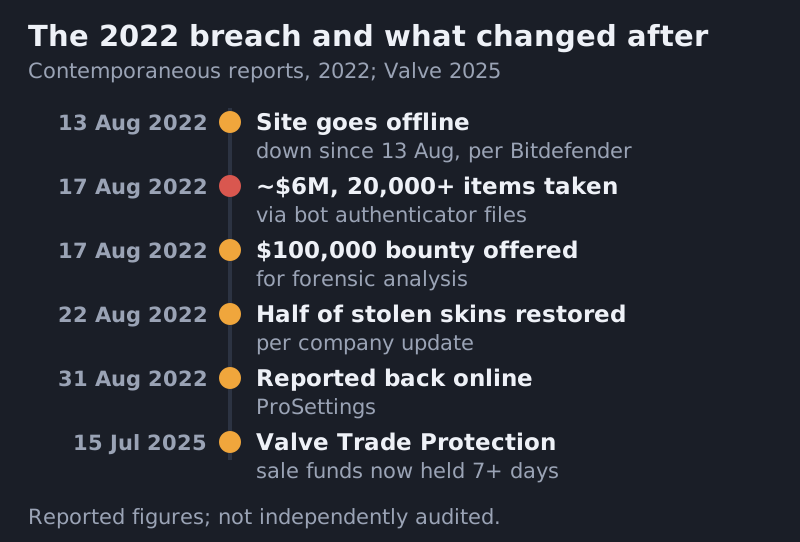
Older pages date the hack to November 2022. Contemporaneous reports put it in mid-August. Bitdefender wrote on 17 August 2022 that the platform had been down since 13 August. Attackers had obtained the mobile authenticator files used to authorise the site's Steam bots and taken over the bots. Over 20,000 items worth about $6 million were moved, with roughly 1,000 transactions to 100 accounts on the first day. The company took the site offline, offered $100,000 for forensic analysis of the attack, and said returning skins and compensating users would be its priority.
By 22 August an update said half the stolen skins had been restored. ProSettings reported on 31 August 2022 that the site was back online after the vulnerabilities were patched, with affected users to be compensated in skins or site credit. We found no independent audit of how complete that compensation was, and we're not going to guess. What the episode shows is a real company that took the loss and reopened. Whether that reassures you or worries you is your call.
Fees by route: the price of instant
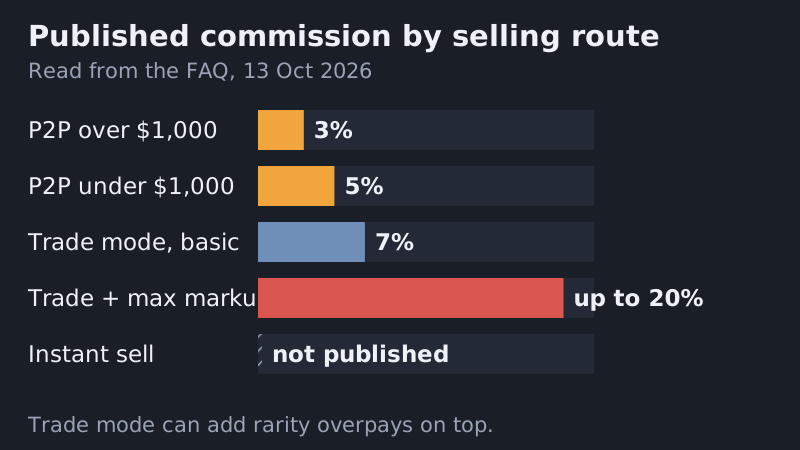
The P2P market is the only route with a plain percentage: 5% for items listed under $1,000 and 3% above. A $100 P2P sale therefore credits $95.00 to your Market balance, after a hold. Trade mode is less transparent. The FAQ calls 7% the "basic commission", then adds a trade-lock markup of 0–13% on bot items that are still locked, and "overpay for rarity" on some stickers, patterns and floats. It also says the site "may not be able to provide" the exact markup in each case.
Instant sell publishes no commission at all. You see a price and accept it or not. The only way to know what an instant offer costs you is to compare it, the same day, with the lowest listing for that exact skin on a peer-to-peer market. We couldn't do that comparison for this page because the offer only shows to a signed-in user with the skin in their inventory. So treat the instant price as a quote, and check it against a 2% market before you click.
Cashing out: what you can actually withdraw
| Balance | Comes from | Withdrawable? | Rule |
|---|---|---|---|
| Market balance | P2P sales; Instant Buy after 7 days | Yes | KYC first; Visa or PayPal by region |
| Instant Buy balance | Instant sell | Not directly | Moves to Market balance after 7 days |
| Trade balance | Trade-mode surplus | No | Spend on the site only |
| Deposited funds | Card or other top-up | No | Purchases only |
The rules are stricter than the marketing. Only Market balance can be withdrawn, and only after you've verified your identity. The FAQ says KYC is otherwise optional but becomes mandatory for withdrawals or if suspicious activity is detected. Payouts go to Visa cards and PayPal wallets "depending on your region". The site charges no withdrawal fee of its own, though your payment provider may, and the minimum depends on the payment system. Cash-out isn't supported in some countries at all; the site's Cashout page lists where it works.
Timing has a wrinkle. The cash-out FAQ says Market balance from sales becomes available "after the seven-day hold", while the P2P selling FAQ says funds arrive "only after an eight-day hold". Plan for eight days. The hold exists because of Valve's Trade Protection, which since 15 July 2025 lets either side reverse a CS2 trade for seven days.
Safety checklist before you trade
- Session cookies: P2P selling asks you to grant access to your Steam session cookies and to install the site's browser extension. The site says you can revoke access in account settings. Decide whether you're comfortable with that before you list, and revoke it when you stop selling.
- Look-alike bots: a cancelled offer followed by an identical new one is the trade-redirection scam Valve describes. It works only when your Steam account is already compromised.
- Reversals: the site's own FAQ warns that cancelling trades reverts every trade from the last 7 days, including legitimate ones. It also says a reversal brings a 30-day trading ban, and Steam's own Trade Protection FAQ agrees: the account that reverses is barred from trading and the Market for 30 days.
- Typed addresses: sign in by typing the address yourself; never through a link from a chat or a giveaway.
- Balances: don't deposit money hoping to withdraw it later. Deposits can only be spent.
None of this is unique to one site. The session-cookie step is the unusual one, and it's worth a conscious yes rather than a reflexive click.
Alternatives when the goal is cash
If you're selling for money rather than swapping skins, compare against markets with a published fee and a published payout path. On a $100 sale, CSFloat's 2% fee leaves a new seller $95.55 after its withdraw fee, about the same as this site's P2P route. Skinport pays $92.00 to a bank with no payout fee. DMarket credits $98.00 at its 2% rate but doesn't publish withdrawal costs; DMarket is worth a look if that trade-off suits you. The whole field, dated, is in the marketplace audit, and the Skinport side is costed in our Skinport fee breakdown.
Edge cases
- Items over $1,000: the P2P fee drops to 3%, which beats Skinport's 6% high-tier rate.
- Trading locked bot items: expect the 0–13% lock markup; an unlocked copy of the same skin can be priced lower.
- Region without cash-out: P2P and instant sales still work, but the money can only be spent on the site.
- Spending, not cashing out: Instant Buy balance can buy items tagged for instant purchase straight away; only the withdrawal waits seven days.
- Steam credit is fine: if the proceeds are going back into games, read Steam Market vs third-party sites first.
Itemized questions
Is CS.MONEY safe in 2026?
Was CS.MONEY hacked?
Can you withdraw real money from CS.MONEY?
Why does CS.MONEY pay less than Steam?
Is CS.MONEY available in the US?
Balance this against the field: the best ecommerce website builders, ranked, or the marketplace audit.